
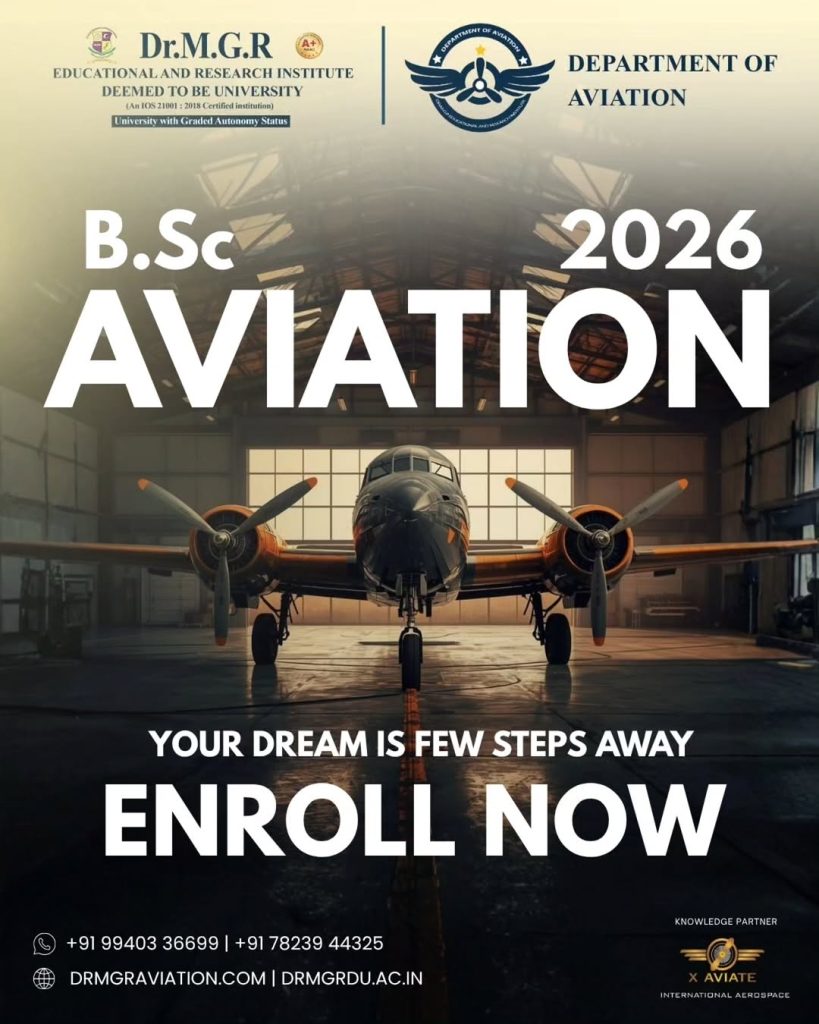
Your Dream Career is Clearing for Takeoff: B.Sc Aviation 2026 Admissions Open!
The hangar doors are opening, and your future in the skies is waiting. At Dr. M.G.R. Educational and Research Institute, we believe that your dream of a career in the clouds should be more than just an aspiration—it should be a destination.
With our B.Sc Aviation 2026 intake now open, that destination is just a few steps away.
Master the Skies with the Department of Aviation
Aviation is a field that demands precision, passion, and world-class training. Our B.Sc program is meticulously crafted to ensure you don’t just learn about aircraft; you master the industry.
Why the 2026 Batch is Your Best Choice:
Cutting-Edge Curriculum: Integrated learning covering aerodynamics, meteorology, air regulations, and navigation.
University Prestige: Graduate from a NAAC A+ accredited institution with Graded Autonomy Status.
Industry Partnership: Benefit from the expertise of our knowledge partner, X Aviate International Aerospace, bridging the gap between the classroom and the cockpit.
Career Paths You Can Pursue
A B.Sc in Aviation opens doors to a variety of high-profile roles within the global aerospace ecosystem:
Commercial Pilot: Command the flight deck of major airlines.
Flight Operations Officer: Manage the safety and efficiency of flight missions.
Air Traffic Controller: Direct the flow of aircraft in the world’s busiest skies.
Aviation Management: Lead the business and logistical side of international airports.
Step Into Your Future
Your dream is no longer a distant horizon. It’s a tangible path that begins with the right education. Join the Department of Aviation and transform your passion into a prestigious profession.
“Aviation is proof that, given the will, we have the capacity to achieve the impossible.”
Core Competencies Developed Through Rigorous Academic Training
Pursuing a degree in aviation requires a unique blend of scientific precision and practical problem-solving abilities. Throughout the program, students engage with complex theoretical concepts that form the backbone of modern flight operations. Understanding the delicate balance of aerodynamic forces, interpreting meteorological data to predict severe weather patterns, and applying complex navigational mathematics are foundational to mastering the discipline.
Beyond the technical mechanics of flight, scholars develop critical cognitive skills essential for high-stress environments. Rapid decision-making, situational awareness, and crew resource management are embedded into the daily academic routine. Future aviation professionals must learn to analyze vast amounts of instrumental feedback in real-time, ensuring that safety remains the absolute priority in every operational scenario.
Aligning Personal Attributes with Professional Demands
The aviation industry is uniquely demanding, requiring candidates who possess specific behavioral and psychological traits. The ideal candidate exhibits unwavering discipline, exceptional emotional resilience, and a profound respect for standard operating procedures. Because aviation is a truly globalized sector, cross-cultural communication skills and adaptability are equally critical for success in international environments.
- Diligent Work Ethic: Commitment to continuous study and mastery of ever-evolving regulatory frameworks.
- Effective Communication: Clear, concise transmission of vital information under pressure to co-pilots and ground crews.
- Leadership Potential: Ability to take decisive charge during unexpected operational anomalies.
Strategic Preparation for Aspiring Aviation Professionals
Entering the competitive world of aerospace demands proactive preparation long before the first official lecture begins. Candidates should cultivate a strong foundational grasp of mathematics and physics, as these subjects underpin all technical aspects of flight training. Staying informed about global aerospace trends, technological innovations in aircraft design, and shifts in international air transport policies will provide a distinct academic advantage.
Furthermore, aspiring professionals should focus on physical and mental well-being. Maintaining high standards of personal health, visual acuity, and cognitive agility is mandatory for medical certification in the aviation sector. By cultivating these holistic habits early, students ensure they are fully prepared to meet the rigorous demands of both classroom education and future field operations.
Frequently Asked Questions
What academic background is required to begin studying aviation?
Students typically need a strong foundation in secondary education, particularly focusing on scientific subjects such as mathematics and physics, which are vital for understanding technical flight principles.
How does academic training translate to real-world aviation roles?
The curriculum bridges theoretical knowledge with practical operational scenarios, preparing graduates to manage complex tasks like flight dispatch, safety auditing, and air traffic oversight.
What steps can candidates take to prepare for medical and regulatory clearances?
Candidates should maintain optimal physical and mental fitness, ensuring they meet the stringent health standards established by civil aviation authorities for industry professionals.