
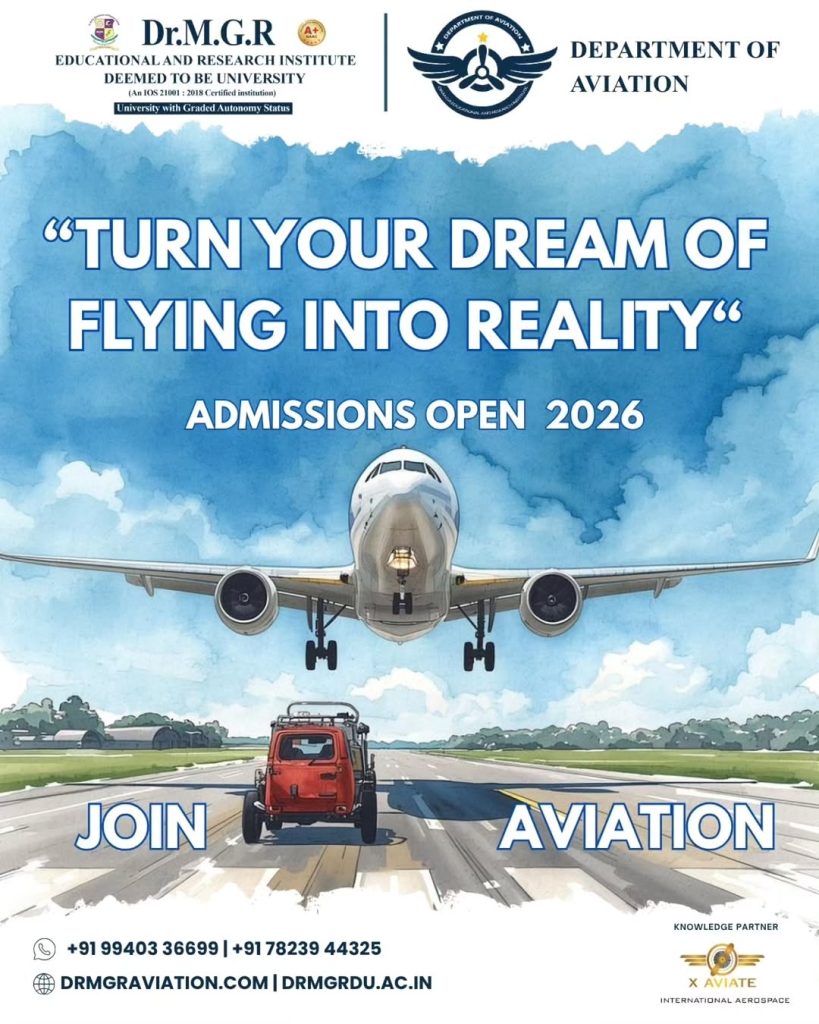
Turn Your Dream of Flying Into Reality: 2026 Aviation Admissions Open!
That upward gaze every time a plane roars overhead doesn’t have to remain just a childhood fascination. The sky is a vast landscape of professional opportunity, and your dream of navigating it—or managing the complex systems that make it possible—is entirely within reach.
At Dr. M.G.R. Educational and Research Institute, we are officially announcing that Admissions for 2026 are now open at our Department of Aviation!
Your Runway to Success
The aviation sector is one of the most dynamic and rapidly evolving industries in the world. Stepping into this field means choosing a career defined by global connectivity, cutting-edge technology, and unparalleled adventure.
Why launch your career with us?
Exceptional Academic Standards: Study at a premier institution recognized as a Deemed to be University, holding a prestigious NAAC A+ grade and Graded Autonomy Status.
Industry-Backed Curriculum: We bridge the gap between academic theory and real-world application through our esteemed knowledge partner, X Aviate International Aerospace.
Holistic Development: We don’t just teach the mechanics of flight; we groom the next generation of aviation leaders, managers, and operational experts.
Join the Department of Aviation
Whether you envision yourself in the cockpit, managing busy airport terminals, or overseeing critical flight operations, your journey begins on the ground with the right education. Don’t let your ambitions stay grounded.
“The engine is the heart of an airplane, but the pilot is its soul. Turn your dream of flying into reality.”
Navigating the Modern Aviation Curriculum: What Students Master
Entering the aviation sector requires a rigorous understanding of both theoretical principles and operational realities. Our academic framework is meticulously designed to equip aspirants with a comprehensive grasp of modern aeronautical science, aerospace management, and technical navigation. Students delve into complex subjects such as aviation meteorology, air navigation, aircraft systems, and air traffic control procedures. Beyond the cockpit, the curriculum emphasizes the critical business aspects of the industry, including airport planning, airline economics, safety management systems, and regulatory frameworks established by international civil aviation authorities.
The learning experience extends far beyond traditional textbooks. Through simulation labs, practical workshops, and scenario-based training, scholars analyze real-world case studies involving flight operations and crisis management. This ensures that every graduate possesses the critical thinking and rapid decision-making capabilities demanded by high-stakes environments. Whether mastering the nuances of aerodynamics or optimizing ground handling logistics, our students build a formidable foundation of knowledge that commands respect across the global aviation community.
Mapping Your Trajectory: Core Competencies and Career Horizons
Success in aviation demands a unique blend of technical proficiency, situational awareness, and exceptional leadership qualities. As the industry expands, employers actively seek professionals who demonstrate unwavering discipline, effective communication, and the ability to adapt to fast-paced technological advancements. Our training programs are structured to cultivate these essential traits, preparing individuals to step seamlessly into multifaceted roles upon graduation.
- Commercial Pilot Training: Focuses on precision flying, instrument rating, and advanced aircraft handling for aspiring aviators.
- Airport Management: Prepares professionals to oversee terminal operations, passenger services, security protocols, and regulatory compliance.
- Flight Operations Dispatch: Trains experts to coordinate flight plans, monitor weather patterns, and ensure safe routing for commercial carriers.
- Aviation Safety and Quality Assurance: Equips specialists to audit operational procedures and maintain the highest standards of safety compliance.
Frequently Asked Questions
What are the primary educational requirements to enroll in aviation programs?
Applicants typically need a strong foundational background in secondary education, with a particular emphasis on science and mathematics subjects, alongside meeting institutional entrance standards and medical fitness criteria.
How does formal education prepare students for industry certifications?
Our academic courses align closely with global aviation standards and regulatory syllabi, providing the comprehensive theoretical knowledge and practical insights required to successfully clear official licensing and certification examinations.
Are there opportunities for practical learning and industry exposure during the course?
Yes, students benefit from a balanced approach that combines classroom instruction with practical training methodologies, interactive workshops, and exposure to real-world operational scenarios to ensure career readiness.