
The aviation industry is built on precision, safety, technical expertise, and continuous learning. Every successful aviation professional—whether a pilot, airport operations executive, flight dispatcher, or aviation manager—begins with a strong understanding of aeronautical knowledge.
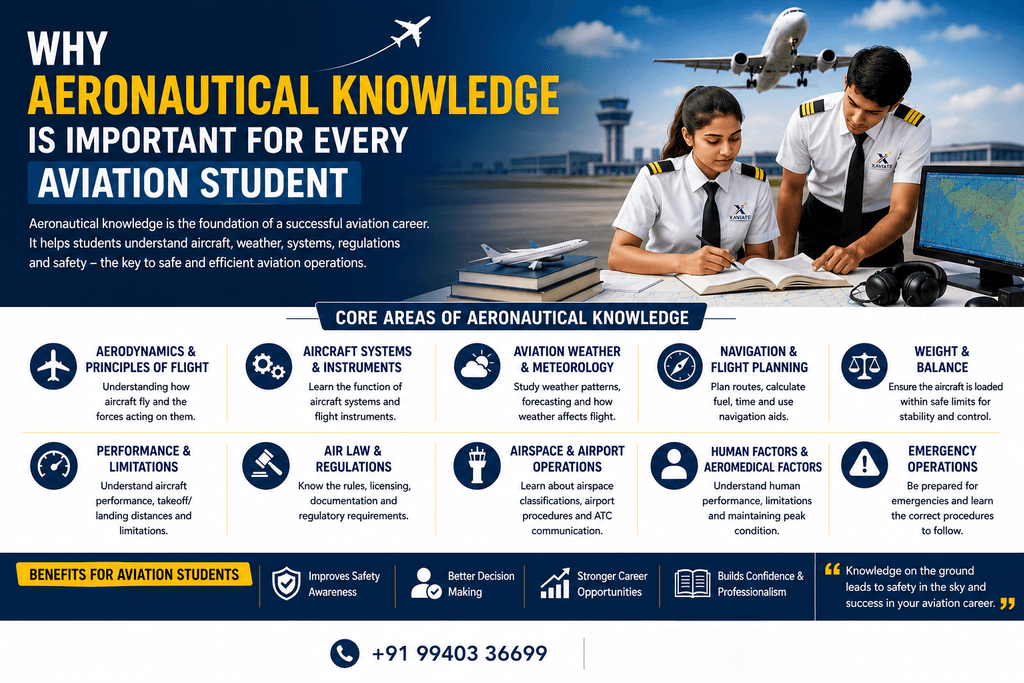
While practical training develops operational skills, theoretical knowledge enables aviation professionals to understand why an aircraft behaves in a certain way, how aviation systems function, and what decisions should be made under different operating conditions.
For students pursuing aviation education, aeronautical knowledge forms the academic foundation that supports future professional success.
What is Aeronautical Knowledge?
Aeronautical knowledge refers to the scientific, technical, operational, and regulatory understanding required to safely participate in aviation activities.
It combines multiple disciplines, including:
- Aircraft operations
- Aviation science
- Meteorology
- Navigation
- Aviation regulations
- Human performance
- Flight safety
- Aircraft performance
Rather than memorizing facts, students learn how these subjects work together to support safe and efficient aviation operations.
Why Every Aviation Student Must Learn Aeronautical Knowledge
1. It Builds a Strong Foundation for Aviation Education
Every aviation course introduces concepts that are interconnected.
Students studying aircraft operations, airport management, airline procedures, or aviation safety will encounter technical principles that require a solid theoretical background.
Understanding these concepts early improves classroom learning and practical training.
2. Safety Begins with Knowledge
Safety is the highest priority in aviation.
Understanding topics such as:
- aircraft limitations
- weather hazards
- runway operations
- emergency procedures
- aviation regulations
helps future professionals identify risks before they become incidents.
Knowledge supports better judgement, situational awareness, and operational discipline.
3. Students Learn How Aircraft Actually Operate
Aircraft are highly sophisticated engineering systems.
Aviation students study:
- flight controls
- aircraft engines
- electrical systems
- hydraulic systems
- navigation instruments
- communication equipment
This understanding allows students to appreciate how different aircraft systems interact during normal and abnormal operations.
4. Weather Knowledge Improves Operational Awareness
Weather influences every stage of flight.
Students learn how to interpret aviation weather information, understand atmospheric conditions, and recognize hazards such as:
- thunderstorms
- wind shear
- turbulence
- icing
- low visibility
- crosswinds
Developing weather awareness improves decision-making and operational safety.
5. Navigation Skills Strengthen Aviation Competency
Navigation is more than following a route.
Students gain knowledge of:
- aeronautical charts
- GPS navigation
- radio navigation
- flight planning
- fuel calculations
- airspace procedures
These concepts help aviation professionals operate efficiently while complying with established procedures.
6. Understanding Aviation Regulations is Essential
The aviation industry operates under national and international regulations.
Students become familiar with:
- aviation legislation
- operational procedures
- documentation requirements
- safety compliance
- airport regulations
Knowledge of these regulations prepares graduates for professional aviation environments.
7. Human Factors are Critical to Aviation Safety
Modern aviation recognizes that human performance significantly affects safety.
Students study:
- fatigue management
- stress
- communication
- decision making
- situational awareness
- Crew Resource Management (CRM)
Understanding human factors helps reduce operational errors and improves teamwork.
8. Emergency Preparedness Builds Confidence
Unexpected situations require calm and informed responses.
Aeronautical education introduces students to emergency procedures including:
- engine failures
- fire response
- evacuation procedures
- communication during emergencies
- contingency planning
Preparation improves confidence and promotes safer aviation practices.
Core Subjects Covered in Aeronautical Knowledge
Students pursuing aviation education commonly study:
- Principles of Flight
- Aircraft Systems
- Aviation Meteorology
- Air Navigation
- Weight and Balance
- Aircraft Performance
- Aviation Regulations
- Airport Operations
- Aviation Safety Management
- Human Factors
- Aviation Communication
- Emergency Procedures
Together, these subjects prepare students for both academic success and professional responsibilities.
Career Benefits of Strong Aeronautical Knowledge
A solid understanding of aeronautical principles benefits students pursuing careers such as:
- Airport Operations Executive
- Airline Operations Executive
- Flight Dispatcher
- Ground Operations Officer
- Aviation Safety Officer
- Airline Customer Service Executive
- Cargo Operations Executive
- Flight Planning Officer
- Aviation Management Professional
- Commercial Pilot (with required flight training and licensing)
Employers value graduates who demonstrate technical understanding alongside communication, professionalism, and operational awareness.
How Aviation Institutes Develop Aeronautical Knowledge
Leading aviation institutions combine classroom instruction with practical exposure through:
- interactive lectures
- simulation-based learning
- laboratory sessions
- airport visits
- industry seminars
- aviation workshops
- guest lectures from aviation professionals
- case-study discussions
This blended approach helps students connect theory with real-world aviation practices.
The Future of Aviation Requires Continuous Learning
The aviation sector continues to evolve with advancements in aircraft technology, automation, sustainable aviation, and digital flight operations.
Professionals who continuously strengthen their aeronautical knowledge remain better prepared to adapt to industry developments and changing regulatory requirements.
Learning does not end with graduation—it continues throughout an aviation career.
Conclusion
Aeronautical knowledge is the foundation upon which successful aviation careers are built. It enables students to understand aviation systems, apply safety principles, make informed decisions, and develop the professional competencies expected by the global aviation industry.
For students aspiring to build a career in aviation, investing time in developing strong theoretical knowledge is as important as gaining practical experience. A balanced combination of academic learning and hands-on exposure creates confident, competent, and safety-conscious aviation professionals.
About Dr. M.G.R. Educational and Research Institute – Department of Aviation
The Department of Aviation at Dr. M.G.R. Educational and Research Institute is committed to providing students with industry-oriented aviation education that combines academic excellence, practical exposure, and professional development. Through experienced faculty, modern learning methodologies, and an emphasis on aviation safety and operational knowledge, the department prepares students for rewarding careers in the aviation industry.