
The aviation industry is built on precision, communication, coordination, and real-time decision-making. For students planning careers in airports, airlines, customer service, or aviation operations, classroom learning alone is not enough. Practical exposure plays an important role in helping students understand how the aviation environment functions professionally.
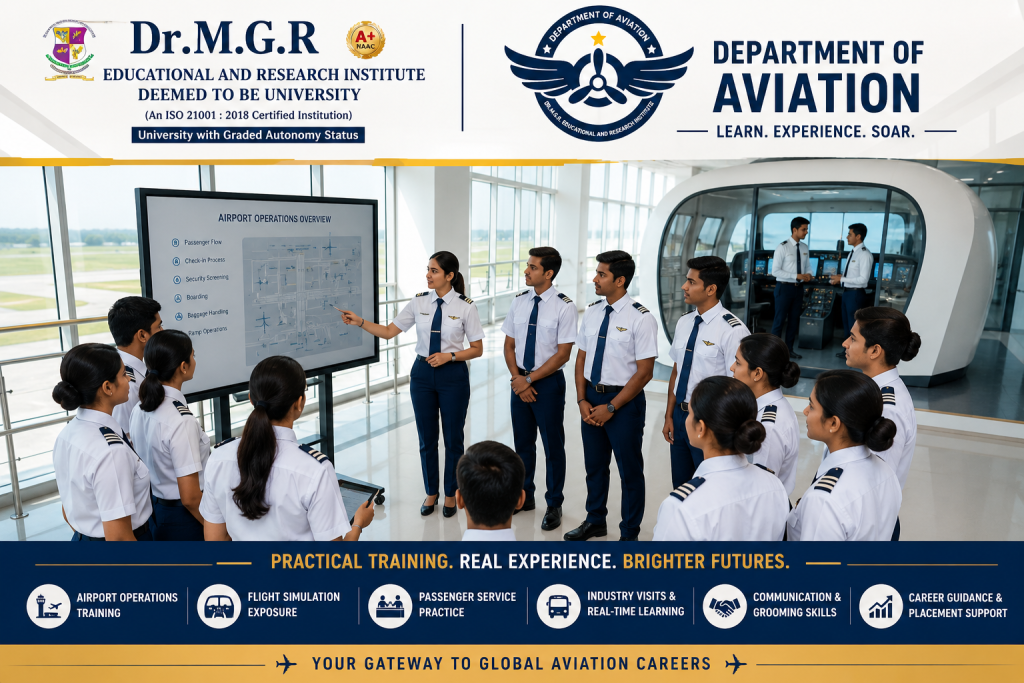
At Dr. M.G.R. Aviation, practical aviation learning is integrated into the training process to help students gain operational understanding, professional confidence, and industry awareness. Through simulation-based activities, airport operation exposure, communication training, and industry interaction, students are introduced to the real-world side of aviation education.
Why Practical Learning Matters in Aviation
Aviation is an operational industry where teamwork, communication, and situational awareness are essential. Employers often look for candidates who can adapt quickly to professional airport and airline environments.
Practical learning helps students:
✈ Understand airport workflows
✈ Improve communication abilities
✈ Develop professional discipline
✈ Build confidence in operational settings
✈ Gain familiarity with airline procedures
This approach helps students transition more smoothly from academic learning to industry environments.
Learning Through Aviation Simulation
Simulation-based training gives students exposure to realistic aviation scenarios and operational procedures. It allows them to understand how coordination happens within airport and airline environments.
Students are introduced to areas such as:
✈ Passenger handling procedures
✈ Airline coordination processes
✈ Airport communication systems
✈ Operational workflow understanding
✈ Safety awareness and response procedures
This type of learning improves practical understanding while helping students become more comfortable in aviation settings.
Mock Airport Training Experience
To help students experience professional airport operations, training activities may include mock airport environments and role-based practical sessions.
These sessions focus on:
✈ Passenger interaction
✈ Boarding procedures
✈ Customer service communication
✈ Ground staff coordination
✈ Check-in process understanding
Practical exposure helps students learn how aviation professionals interact with passengers and manage day-to-day operational responsibilities.
Industry Exposure Beyond the Classroom
Aviation education becomes more meaningful when students are exposed to real industry environments. Industrial visits and observational learning activities help students connect academic concepts with practical aviation operations.
Students gain insights into:
✈ Airport operational systems
✈ Airline support services
✈ Aviation workplace culture
✈ Passenger service management
✈ Ground operations workflow
Such experiences improve professional awareness and help students better understand the expectations of the aviation industry.
Importance of Communication & Professional Grooming
Professional communication is one of the most important skills in aviation. Airports and airlines require professionals who can interact confidently with passengers, colleagues, and operational teams.
At Dr. M.G.R. Aviation, students are encouraged to develop:
✈ Professional communication skills
✈ Team coordination abilities
✈ Customer interaction confidence
✈ Workplace etiquette
✈ Interview readiness
These skills are valuable not only in aviation but also in hospitality, logistics, customer service, and corporate environments.
Building Career Readiness Through Practical Exposure
The purpose of practical aviation education is to help students become industry-ready professionals. Exposure to operational learning environments helps students improve adaptability, confidence, and workplace understanding.
Practical training supports students in developing:
✈ Operational awareness
✈ Leadership qualities
✈ Problem-solving mindset
✈ Professional behavior
✈ Industry familiarity
Students who gain early exposure to aviation environments often feel more prepared during internships, interviews, and career opportunities.
Career Opportunities After Aviation Training
Aviation offers opportunities across multiple sectors for students with operational knowledge and professional communication skills.
Students may explore roles in:
✈ Airport operations
✈ Airline customer service
✈ Ground handling coordination
✈ Passenger support services
✈ Aviation administration
✈ Cargo and logistics support
As airport infrastructure and airline services continue to expand, the demand for trained aviation professionals is steadily increasing.
Why Students Prefer Industry-Oriented Aviation Education
Modern students prefer learning experiences that combine theory with practical application. Industry-oriented aviation programs help students understand how the aviation sector functions beyond textbooks.
Practical exposure helps students:
✈ Learn through real scenarios
✈ Build workplace confidence
✈ Improve communication skills
✈ Understand professional expectations
✈ Develop operational knowledge
This creates a more engaging and career-focused learning environment.
Why Choose Dr. M.G.R. Aviation?
Dr. M.G.R. Aviation focuses on creating a balanced aviation education experience that combines academic learning with industry-oriented exposure.
Key Advantages
✈ Practical aviation learning approach
✈ Aviation simulation exposure
✈ Industry interaction sessions
✈ Communication and personality development
✈ Professional mentoring support
✈ Career-focused training environment
The institution aims to help students develop the confidence and skills required for modern aviation careers.
Conclusion
Aviation education today goes beyond traditional classroom teaching. Practical exposure, communication training, simulation learning, and industry interaction are becoming essential parts of preparing students for professional aviation careers.
At Dr. M.G.R. Aviation, students receive opportunities to understand aviation environments through practical learning experiences designed to improve confidence, professionalism, and operational understanding.
For students interested in airport operations, airline management, customer service, or aviation administration, industry-oriented aviation training can become an important first step toward a successful career journey.