
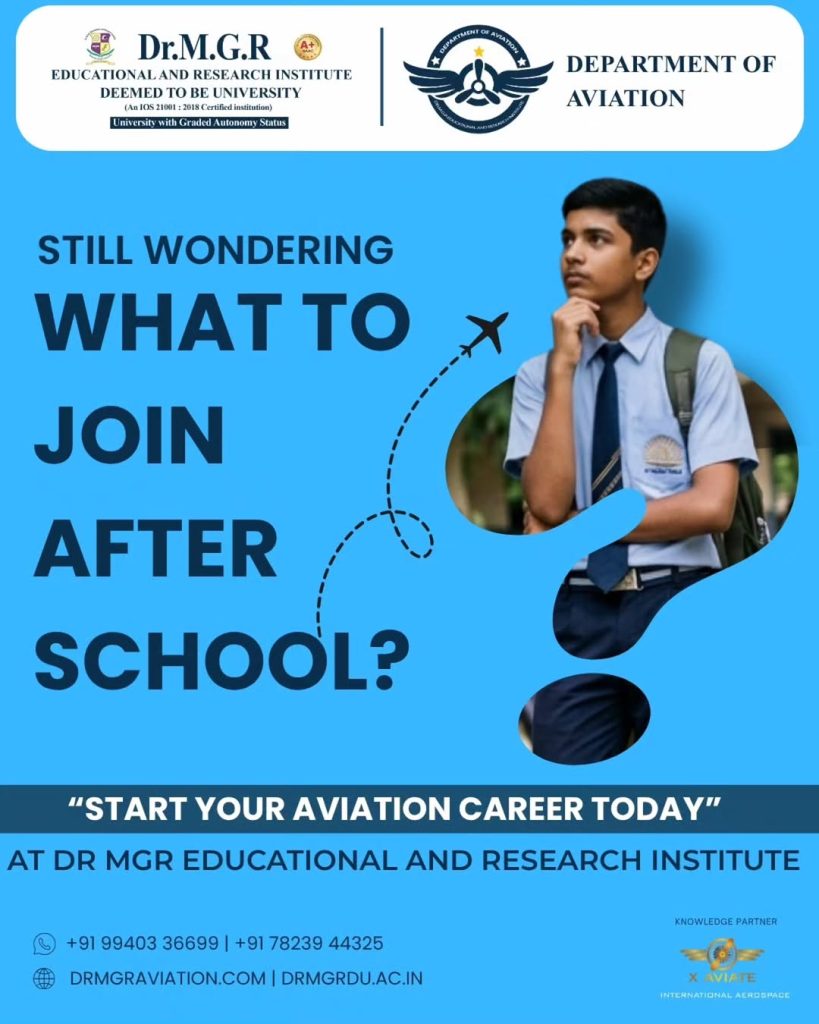
Deciding Your Future After School? Take to the Skies with Dr. M.G.R. University!
The transition from school to college is one of the most significant crossroads in life. While many follow the traditional paths of engineering or medicine, a world of high-speed adventure and global connectivity awaits those who look upward.
If you are still wondering what to join after school, it’s time to stop questioning and start soaring.
Why Choose a Career in Aviation?
Aviation isn’t just a job; it’s a lifestyle. Beyond the prestige of the uniform, the aerospace sector offers:
Global Exposure: Work in an industry that connects continents.
Rapid Growth: With air travel expanding globally, the demand for trained professionals is at an all-time high.
Dynamic Work Environment: Say goodbye to the boring 9-to-5 desk job.
Why Dr. M.G.R. Educational and Research Institute?
At the Department of Aviation, we don’t just teach—we prepare you for the cockpit and the control room. Our program is backed by:
Academic Excellence: A university with NAAC A+ accreditation and Graded Autonomy status.
Industry Expertise: Partnered with X Aviate International Aerospace, ensuring our training is current with international standards.
Comprehensive Learning: We provide the technical knowledge and the soft skills required to excel in the competitive aerospace market.
Your Flight Plan Starts Here
Stop the guesswork about your future. Join a program that transforms your curiosity into a high-flying career.
“The engine is the heart of an airplane, but the pilot is its soul.” Start your journey to becoming the soul of the aviation industry today.
Core Competencies and Academic Rigor in Modern Aviation
Entering the aviation sector requires a robust foundation in both theoretical sciences and operational procedures. Students enrolled in our specialized programs delve into a curriculum designed to meet the rigorous demands of the global aerospace industry. The learning journey is structured to build critical thinking, technical proficiency, and situational awareness under pressure.
- Aerodynamics and Flight Physics: Understanding the fundamental forces of lift, drag, thrust, and weight that govern aircraft movement.
- Navigation and Meteorology: Mastering flight planning, instrument interpretation, and weather pattern analysis to ensure safe routing.
- Aviation Safety and Regulations: Studying international air law, safety management systems, and emergency protocols mandated by global aviation authorities.
- Aircraft Systems: Gaining deep insights into propulsion mechanics, avionics, electrical frameworks, and structural maintenance.
Identifying the Ideal Candidate: Is Aviation Right for You?
A career in aviation demands a unique blend of personal attributes, physical readiness, and mental agility. While academic dedication is paramount, certain inherent traits often distinguish successful aviation professionals from their peers.
- Decisive Problem-Solving: The ability to evaluate complex scenarios rapidly and execute precise decisions in high-stress environments.
- Communication Excellence: Clear, concise verbal communication is vital for coordinating with air traffic control, flight crews, and ground personnel.
- Adaptability: Thriving in changing time zones, dynamic weather conditions, and non-routine operational schedules.
- Commitment to Continuous Learning: Aviation technology evolves constantly, requiring professionals to regularly update their certifications and operational knowledge.
Diverse Career Trajectories Beyond the Cockpit
While piloting commercial aircraft remains a primary aspiration for many, the broader aviation ecosystem offers a multitude of specialized career paths for qualified graduates. Management, operations, and technical support sectors are vital components of the global aerospace network.
- Airport Operations Management: Overseeing ground services, passenger flow, terminal logistics, and regulatory compliance on the ground.
- Air Traffic Control Support: Assisting in the safe and orderly flow of air traffic within controlled airspace corridors.
- Aviation Safety Inspectorate: Monitoring operational standards, conducting safety audits, and ensuring adherence to international aviation guidelines.
- Airline Corporate Administration: Managing fleet logistics, route planning, human resources, and commercial strategy for major carriers.
Frequently Asked Questions
What academic background is required to begin studying aviation?
Most foundational programs look for students with a strong secondary education background, particularly in sciences and mathematics, as these subjects underpin the technical principles of flight and aerospace engineering.
Are practical training sessions integrated into the curriculum?
Yes, comprehensive aviation education combines rigorous classroom instruction with simulated operational environments, practical workshops, and scenario-based training to prepare students for real-world industry demands.
How does the aviation industry accommodate technological advancements?
Modern curricula are continuously updated to incorporate emerging technologies, advanced avionics systems, digital navigation tools, and evolving environmental sustainability practices implemented by international aviation bodies.