
When an aircraft takes off, it doesn’t simply fly in a straight line to its destination. Every flight follows a carefully planned route using advanced air navigation systems, global aviation standards, and constant communication with air traffic control. Air navigation is one of the most essential pillars of aviation safety, ensuring aircraft reach their destinations accurately, efficiently, and safely.
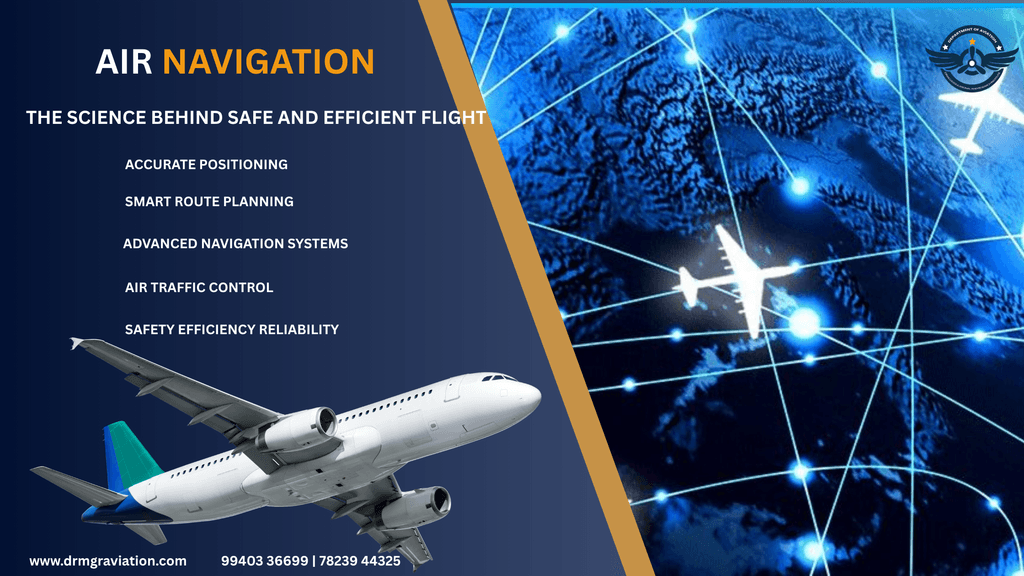
Whether you dream of becoming a commercial pilot, air traffic controller, or aviation professional, understanding air navigation is a fundamental part of aviation education.
What is Air Navigation?
Air navigation is the process of planning, directing, and controlling an aircraft’s movement from departure to destination. It involves determining the aircraft’s position, selecting the safest route, and making continuous adjustments throughout the flight.
Modern air navigation combines traditional navigation techniques with advanced satellite-based technologies to improve accuracy, efficiency, and safety. ICAO promotes global standards for communication, navigation, and air traffic management to ensure aircraft can operate safely across international airspace.
Why is Air Navigation Important?
Effective air navigation provides several critical benefits:
- Enhances flight safety
- Reduces fuel consumption
- Improves operational efficiency
- Minimizes flight delays
- Supports accurate route planning
- Ensures compliance with international aviation regulations
Without reliable navigation systems, safe aircraft operations would be impossible, particularly during poor weather conditions or international flights.
Types of Air Navigation
1. Pilotage
Pilotage is one of the oldest navigation methods. Pilots navigate by identifying visible landmarks such as rivers, highways, cities, lakes, or mountains.
This method is primarily used during Visual Flight Rules (VFR) operations when weather conditions provide clear visibility.
2. Dead Reckoning
Dead reckoning calculates the aircraft’s current position based on:
- Heading
- Airspeed
- Time
- Wind direction
- Wind speed
Although modern aircraft rely heavily on electronic navigation, dead reckoning remains an essential backup skill for pilots.
3. Radio Navigation
Radio navigation uses ground-based navigation aids, including:
- VOR (VHF Omnidirectional Range)
- NDB (Non-Directional Beacon)
- DME (Distance Measuring Equipment)
- ILS (Instrument Landing System)
These systems provide direction, distance, and precision approach guidance, especially during Instrument Flight Rules (IFR) operations.
4. Satellite Navigation (GPS/GNSS)
Today’s commercial aircraft primarily use GPS and other Global Navigation Satellite Systems (GNSS).
Satellite navigation offers:
- High positional accuracy
- Real-time aircraft tracking
- Global coverage
- Efficient routing
- Enhanced flight safety
Modern GNSS includes systems such as GPS, Galileo, GLONASS, and BeiDou, supported by ICAO standards for aviation use.
Performance-Based Navigation (PBN)
Modern aviation increasingly relies on Performance-Based Navigation (PBN).
Instead of depending solely on ground-based navigation aids, PBN allows aircraft to fly precise routes using onboard navigation systems, improving:
- Airspace efficiency
- Fuel savings
- Flight safety
- Airport accessibility
- Environmental sustainability
Performance-Based Navigation includes technologies such as RNAV (Area Navigation) and RNP (Required Navigation Performance).
Key Air Navigation Equipment
Pilots use multiple navigation systems throughout a flight, including:
- Flight Management System (FMS)
- GPS Receiver
- VOR Receiver
- DME
- Automatic Direction Finder (ADF)
- Inertial Navigation System (INS)
- Glass Cockpit Navigation Displays
These systems continuously provide accurate information about aircraft position, heading, altitude, speed, and planned route.
The Role of Air Traffic Control (ATC)
Air Traffic Control works closely with pilots to ensure safe aircraft separation and efficient traffic flow.
ATC responsibilities include:
- Providing departure clearances
- Monitoring aircraft positions
- Assigning safe altitudes
- Managing airspace traffic
- Coordinating arrivals and departures
- Assisting during emergencies
Together, pilots and air traffic controllers maintain one of the safest transportation systems in the world.
Career Opportunities in Air Navigation
Knowledge of air navigation is valuable for several aviation careers:
- Commercial Pilot
- Airline Pilot
- Flight Dispatcher
- Air Traffic Controller
- Flight Operations Officer
- Aviation Safety Officer
- Airport Operations Executive
As aviation technology continues to evolve, professionals with strong navigation knowledge remain in high demand worldwide.
Learn Air Navigation with Dr. M.G.R Department of Aviation
At Dr. M.G.R Department of Aviation, students receive industry-oriented aviation education that combines theoretical knowledge with practical exposure. Air navigation is a key part of the curriculum, helping students understand modern aircraft navigation systems, aviation regulations, flight planning, and operational procedures.
With experienced faculty, aviation-focused training, and career guidance, students gain the knowledge and confidence required to build successful careers in the global aviation industry.
Final Thoughts
Air navigation is far more than simply finding the shortest route between two airports. It is a sophisticated combination of technology, precision, communication, and international aviation standards that keeps millions of passengers safe every day. From traditional navigation methods to advanced GPS and Performance-Based Navigation systems, mastering air navigation is an essential step for every future aviation professional.
If you’re passionate about aviation and aspire to build a rewarding career in the industry, learning air navigation is the perfect place to begin.